

Polycystin-1 (PKD1) Antibody
Description
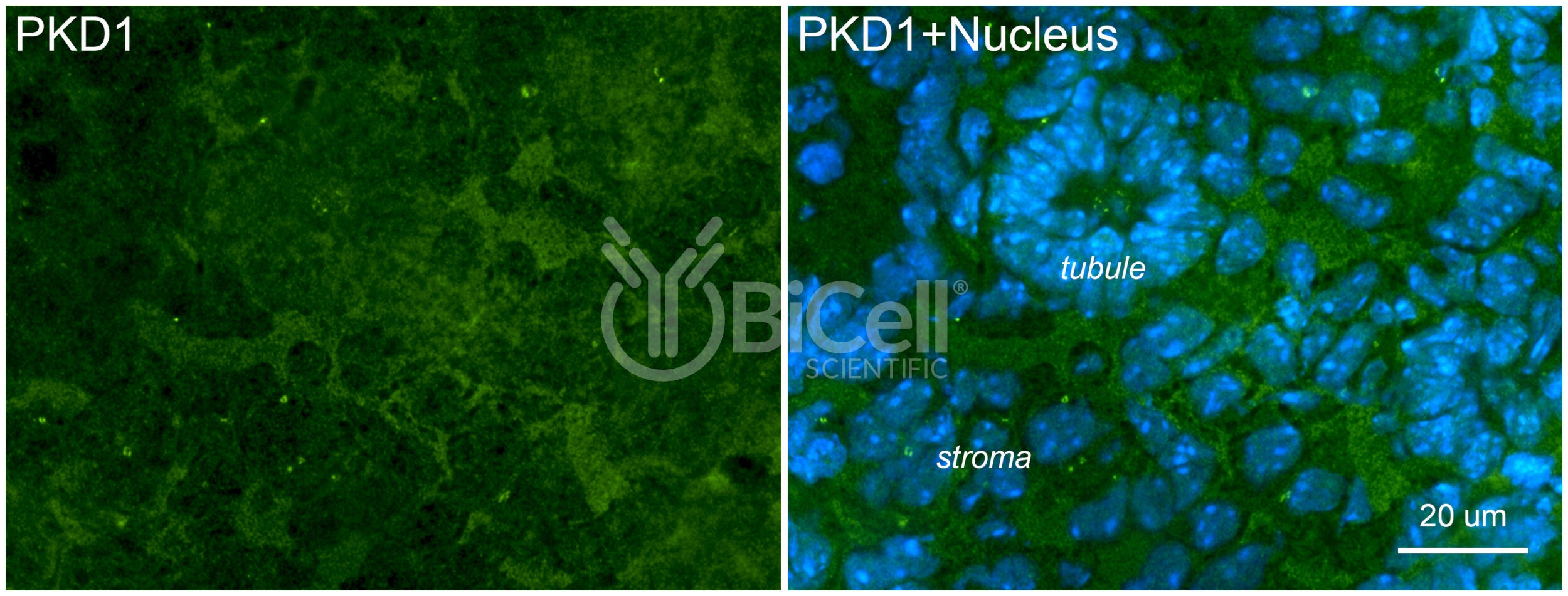
Anti-Polycystin-1 (PKD1) antibody is validated on mouse tissue and can be used for immunofluorescence labeling, IHC, or western blot of materials from rodent and human tissues. Polycystin-1, also known as Transient receptor potential polycystin-1 cation channel (TRPP1), is encoded by the PKD1 gene in human. Polycystin-1 contains a large N-terminal extracellular region, eleven transmembrane domains and a cytoplasmic C-tail. It is an integral membrane protein that functions as a regulator of calcium permeable cation channels and intracellular calcium homoeostasis. It is also involved in cell-cell/matrix interactions and may modulate G-protein-coupled signal-transduction pathways. Polycystin-1 plays a role in renal tubular development, and mutations in this gene cause autosomal dominant polycystic kidney disease type 1 (ADPKD1) (OMIM 173900).
| Application: | Immunofluorescence, Immunohistochemistry, Western Blot |
|---|---|
| Clonality: | Polyclonal |
| Concentration: | 0.25 mg/ml |
| Conjugation: | Unconjugated |
| Host: | Rabbit |
| Immunogen: | Synthetic peptide (17-aa) derived from the N-terminal extracellular region of human Polycystin-1 protein |
| Isotype: | IgG |
| Purification: | Affinity Chromatography |
| Reactivity: | Human, Mouse, Rat |
| Species Homology: | Synthetic peptide sequence is identical to mouse or rat sequence |
| Storage: | -20°C |
| Storage Buffer: | PBS, pH 7.2, 0.1% Sodium Azide |