
AGO1 Antibody - FFPE Validated

BiCell Scientific
SKU:51701-FFPE-50UL
Couldn't load pickup availability
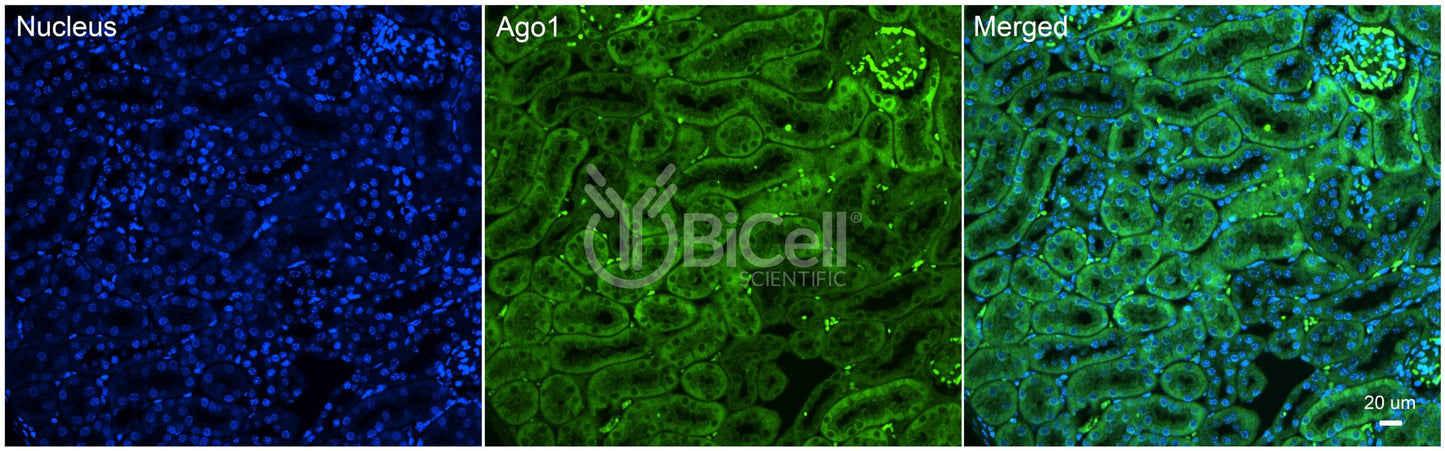
About the Target
When you need to analyze AGO1 with attention to cellular organization, this antibody provides a focused option. AGO1 is a signaling node often evaluated by abundance, localization, and modification-dependent states. Its behavior can reflect changes in differentiation state, stress, or remodeling of cellular architecture.
Tracking AGO1 can clarify whether changes reflect regulation, redistribution, or altered complex assembly.
Research Context
When comparing conditions, consistent sample handling and normalization are key for meaningful contrasts. Because regulation can be multi-layered, combining abundance and localization information can sharpen conclusions.
Consider these angles when interpreting target-level changes:
- interaction patterns within multi-protein complexes
- localization shifts between cytoplasm, membrane, and nucleus
- time-resolved changes following stimulation or inhibition
Variant Considerations
This fixed-section oriented version is intended for paraffin-embedded tissue, where crosslinking and retrieval steps can shape epitope accessibility. This matters because epitope exposure and background can vary with preparation and extraction steps. If you compare conditions, keep processing steps uniform to support clean interpretation.
To support downstream analysis, record key context variables (culture timing, stimulation window, and extraction approach) so AGO1 patterns can be compared across experiments without guesswork.
If your study spans multiple model systems, it can help to define a shared reference condition for AGO1 so cross-sample contrasts stay meaningful.
As you refine hypotheses around AGO1, the fixed-section format helps keep conclusions tied to preparation context.
- Targets:
- AGO1
- Research Area:
- Cell Signaling • Epigenetics
- Application:
- IHC-P
- Reactivity:
- Human • Mouse • Rat
- Host:
- Rat
- Clonality:
- Polyclonal
- Isotype:
- IgG
- Immunogen:
- Synthetic peptide (15-aa) derived from the N-terminal region of human AGO1 protein
- Conjugation:
- Unconjugated
- Purification:
- Affinity Chromatography
- Concentration:
- 0.25 mg/ml
- UniProt:
- Q9UL18
- Homology:
- Synthetic peptide sequence is identical to mouse or rat sequence
- Storage Buffer:
- PBS, pH 7.2, 0.1% Sodium Azide
- Storage Temperature:
- -20°C
For Research Use Only. Not intended for diagnostic or therapeutic use.
Products may be subject to intellectual property rights.
The purchase of this product does not grant any license for commercial use, manufacturing, or clinical applications. The user is responsible for ensuring compliance with applicable laws and third-party rights.