
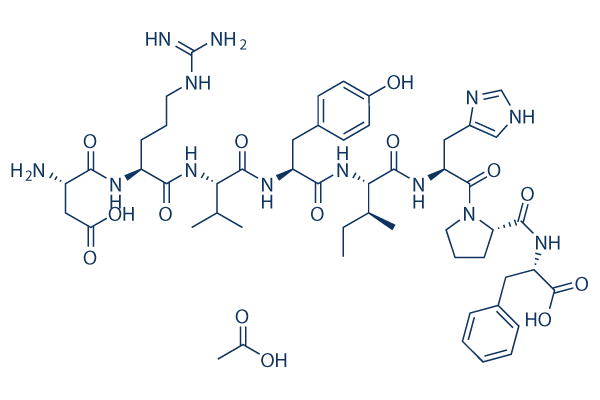
Angiotensin II Human Acetate (DRVYIHPF)

Selleck Chemicals
SKU:P1085-5MG
Couldn't load pickup availability
About the Target
Angiotensin II (angII) is an octapeptide hormone which affects the activities of heart, kidney, vasculature and brain. The mapped target for this entry is Angiotensin II receptors type 1 and 2 (AGTR1 and AGTR2). This target context is most often investigated as part of ligand-responsive signaling, where receptor occupancy can reshape downstream second-messenger output, trafficking, secretion, excitability, or transcriptional programs. In endocrine signaling studies, investigators commonly track ligand-responsive signaling, secretion, and endocrine feedback. This framing is especially useful when investigators want to connect a controlled ligand stimulus with rapidly changing cellular phenotypes.
Research Context
As an agonist-format peptide, it is typically used to trigger pathway activation on demand and to compare acute signaling events with longer adaptive changes such as receptor desensitization or altered transcriptional output. In practice, dose-response design, timing, and matched control conditions are important for separating direct target engagement from delayed compensatory responses. When species annotation matters, keeping comparisons within the stated human context helps reduce ambiguity in receptor or sequence preference. The available sequence cue can also be useful for tracking construct identity across screening and follow-up experiments.
- pair peptide treatment with pathway-proximal signaling or trafficking readouts whenever possible
- compare responses across cell states or model systems with different receptor abundance
- distinguish primary target engagement from downstream adaptation during longer incubations
Experimental interpretation should therefore connect early pathway changes with later phenotypic outputs, rather than relying on a single endpoint in isolation.
Format Considerations
For routine mechanistic work, the unmodified catalog format provides a consistent starting point for concentration-response studies, benchmark experiments, and orthogonal validation. In comparative workflows, keeping the listed acetate format constant across comparator groups can reduce avoidable formulation-related differences; retaining the annotated human species context helps when comparing sequence-dependent biology; documenting the provided sequence cue (DRVYIHPF) can support traceability in comparative studies. This is particularly helpful for comparative experiments, benchmark studies, and orthogonal validation in which small differences in formulation or handling can complicate interpretation. For peptide-centered workflows, conclusions are usually strongest when biological readouts are paired with consistent preparation and appropriately matched reference conditions.
For Research Use Only. Not intended for diagnostic or therapeutic use.
Products may be subject to intellectual property rights.
The purchase of this product does not grant any license for commercial use, manufacturing, or clinical applications. The user is responsible for ensuring compliance with applicable laws and third-party rights.