
ATR Antibody - FFPE Validated

BiCell Scientific
SKU:51302-FFPE-50UL
Couldn't load pickup availability
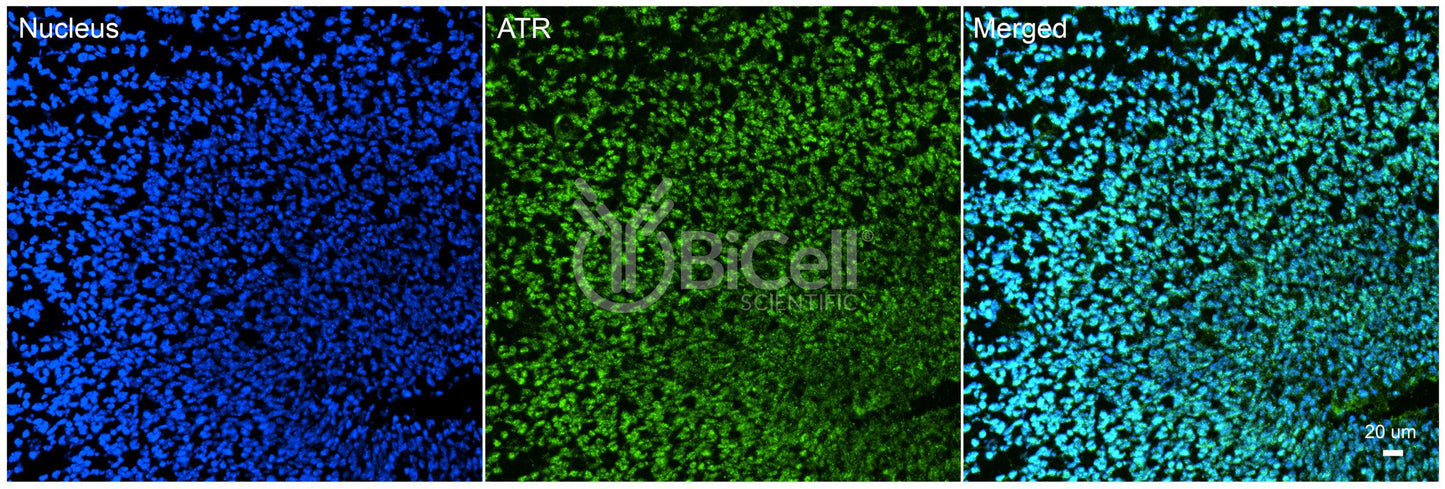
Biological Background
Use this antibody to examine ATR when mapping complex behavior and signaling context. ATR is a regulator within kinase-driven cascades that influence transcriptional and metabolic responses. Many projects interpret this target alongside interacting partners, upstream cues, and downstream readouts.
Tracking ATR can clarify whether changes reflect regulation, redistribution, or altered complex assembly.
Use in the Laboratory
Perturbations such as inhibitors or ligand stimulation can drive rapid shifts in localization or complex formation. Considering complex membership and compartment shifts can clarify whether changes reflect signaling or redistribution. In oncology research models, expression shifts can accompany changes in adhesion, signaling, or differentiation state.
Depending on the model, researchers may ask whether signal shifts reflect altered abundance, compartment changes, or remodeling of associated complexes.
To keep datasets interpretable, labs often document:
- interaction patterns within multi-protein complexes
- time-resolved changes following stimulation or inhibition
- condition-to-condition comparisons with matched controls
Version Notes
Because fixation can mask epitopes, fixed-section oriented formats aim to maintain recognition after standard deparaffinization and retrieval steps. If your study compares multiple conditions, keep acquisition and processing settings stable to avoid confounding.
When interpreting ATR, consider whether changes track with compartment identity, cell density, or perturbation timing; these factors can influence apparent signal without implying a direct causal link.
Use the fixed-section version to relate ATR behavior to upstream cues and downstream consequences.
- Targets:
- ATR
- Research Area:
- Cancer • Cell Cycle • Cell Signaling • DNA Damage / Repair
- Application:
- IHC-P
- Reactivity:
- Human • Mouse • Rat
- Host:
- Rat
- Clonality:
- Polyclonal
- Isotype:
- IgG
- Immunogen:
- Synthetic peptide (19-aa) derived from the N-terminal region of human ATR protein
- Conjugation:
- Unconjugated
- Purification:
- Affinity Chromatography
- Concentration:
- 0.25 mg/ml
- UniProt:
- Q13535
- Homology:
- Synthetic peptide sequence is identical to mouse or rat sequence
- Storage Buffer:
- PBS, pH 7.2, 0.1% Sodium Azide
- Storage Temperature:
- -20°C
For Research Use Only. Not intended for diagnostic or therapeutic use.
Products may be subject to intellectual property rights.
The purchase of this product does not grant any license for commercial use, manufacturing, or clinical applications. The user is responsible for ensuring compliance with applicable laws and third-party rights.