
BBS7 Antibody - FFPE Validated

BiCell Scientific
SKU:90207-FFPE-50UL
Couldn't load pickup availability
Biological Background
This antibody enables you to characterize BBS7 with a direct, biology-first readout. BBS7 is a structural factor that supports primary cilium assembly or signaling competence. Focus on trends across conditions rather than single-point snapshots.
Following BBS7 across perturbations can help separate expression effects from compartment shifts.
Use in the Laboratory
Quantitative comparisons often rely on consistent imaging parameters and clear inclusion criteria for ciliated cells. Pair measurements with orthogonal readouts when interpretation is sensitive to context.
Depending on the model, researchers may ask whether signal shifts reflect altered abundance, compartment changes, or remodeling of associated complexes.
To keep datasets interpretable, labs often document:
- co-occurrence with intraflagellar transport markers
- changes in cilia incidence or apparent length in perturbation studies
- signal enrichment at basal bodies versus cytoplasm
- cell-cycle linked differences in localization
Version Notes
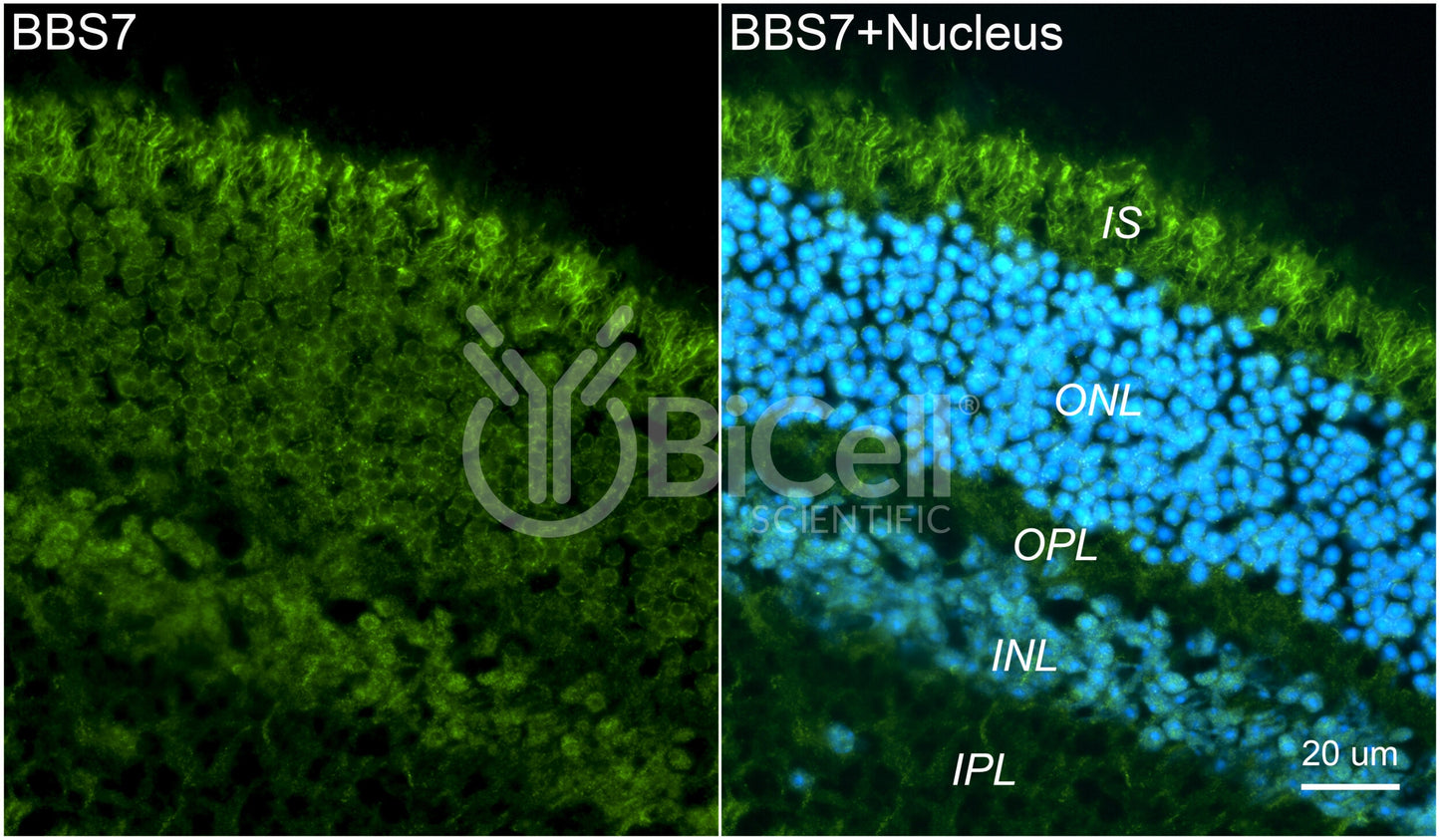
In sectioned tissue workflows, interpretation often depends on morphology; this format supports that style of readout. If your study compares multiple conditions, keep acquisition and processing settings stable to avoid confounding.
When interpreting BBS7, consider whether changes track with compartment identity, cell density, or perturbation timing; these factors can influence apparent signal without implying a direct causal link.
For challenging targets, pairing BBS7 measurements with a second marker can clarify whether differences arise from regulation, redistribution, or shifts in cell composition within the sample.
With a clear focus on BBS7, this fixed-section option fits streamlined studies and fast iteration.
- Targets:
- BBS7
- Research Area:
- Cell Cycle • Developmental Biology
- Application:
- IHC-P
- Reactivity:
- Human • Mouse • Rat
- Host:
- Rabbit
- Clonality:
- Polyclonal
- Isotype:
- IgG
- Immunogen:
- Synthetic peptide (17-aa) derived from the C-terminal region of mouse BBS7 protein
- Conjugation:
- Unconjugated
- Purification:
- Affinity Chromatography
- Concentration:
- 0.25 mg/ml
- UniProt:
- Q8IWZ6
- Homology:
- Synthetic peptide sequence is identical to rat sequence (showing 94.1% homology to human sequence)
- Storage Buffer:
- PBS, pH 7.2, 0.1% Sodium Azide
- Storage Temperature:
- -20°C
For Research Use Only. Not intended for diagnostic or therapeutic use.
Products may be subject to intellectual property rights.
The purchase of this product does not grant any license for commercial use, manufacturing, or clinical applications. The user is responsible for ensuring compliance with applicable laws and third-party rights.