
Disitertide (P144)

Selleck Chemicals
SKU:P1218-5MG
Couldn't load pickup availability
About the Target
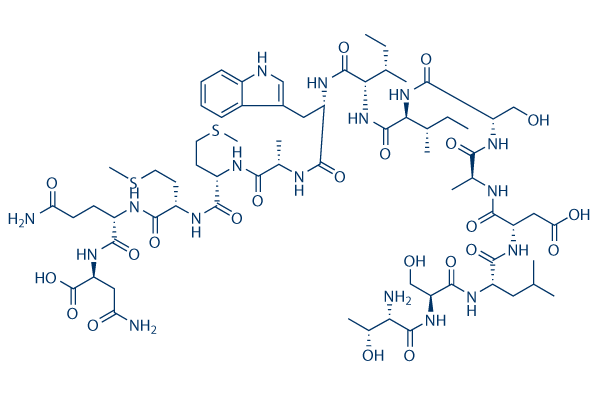
Disitertide (P144) is a peptidic transforming growth factor-beta 1 (TGF-β1) inhibitor specifically designed to block the interaction with its receptor, is also a PI3K inhibitor and an apoptosis inducer. The mapped biological anchor for this entry is TGF-beta1 / PI3K signaling (TGFB1 and PIK3CA), although the description suggests that interpretation should remain at fragment, family, or pathway level. In research settings, this mapped target is typically treated as a catalytic or regulatory node whose activity can alter substrate turnover, pathway flux, and stress responses over relatively short experimental time scales. Across mechanistic studies, investigators commonly track acute pathway activation, receptor trafficking, and downstream transcriptional changes. In practical terms, the entry is well suited to mechanistic studies that require defined perturbation of pathway output over short experimental windows.
Research Context
In inhibitor studies, researchers generally relate exposure to suppression of the mapped pathway, then compare phenotypic readouts with orthogonal markers of target engagement or pathway compensation. In practice, dose-response design, timing, and matched control conditions are important for separating direct target engagement from delayed compensatory responses. Because more than one mapped molecular node is represented in the enrichment, pathway readouts should be interpreted with awareness that the phenotype may integrate multiple signaling inputs.
- link phenotypic changes to catalytic or substrate-based biomarkers rather than relying on a single endpoint
- use timed addition or washout designs when direct and downstream effects need to be separated
- benchmark interpretation with orthogonal pathway controls or reference inhibitors where appropriate
Experimental interpretation should therefore connect early pathway changes with later phenotypic outputs, rather than relying on a single endpoint in isolation.
Format Considerations
Using the regular format helps keep comparative experiments aligned, especially when the same signaling question is being tested across multiple models or readout platforms. In comparative workflows, consistency of preparation, exposure window, and matched controls is often as important as the nominal treatment itself. This is particularly helpful for comparative experiments, benchmark studies, and orthogonal validation in which small differences in formulation or handling can complicate interpretation. For peptide-centered workflows, conclusions are usually strongest when biological readouts are paired with consistent preparation and appropriately matched reference conditions.
For Research Use Only. Not intended for diagnostic or therapeutic use.
Products may be subject to intellectual property rights.
The purchase of this product does not grant any license for commercial use, manufacturing, or clinical applications. The user is responsible for ensuring compliance with applicable laws and third-party rights.