
DROSHA (RNASEN) Antibody

BiCell Scientific
SKU:51704-50UL
Couldn't load pickup availability
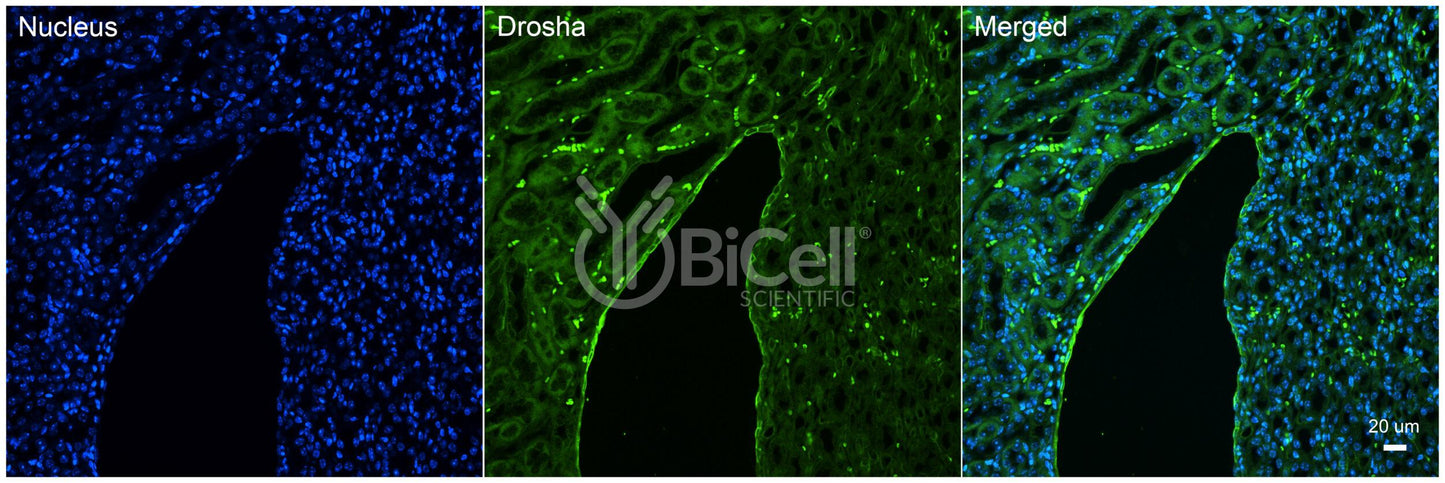
Protein Function
This antibody helps you explore DROSHA (RNASEN) while keeping condition-to-condition contrasts straightforward. DROSHA is a signaling protein that can relay information through phosphorylation and complex assembly. For comparison-heavy studies, consistent sample handling and normalization help reduce run-to-run drift.
In some datasets and protocols, it is referenced by the gene symbol RNASEN.
Experimental Applications
Signaling targets are typically assessed across time courses to capture transient activation windows. Define inclusion criteria and controls early so replicate sets remain interpretable as the dataset grows.
Many workflows benefit from tracking both signal intensity and compartment distribution, especially when the target participates in multi-protein assemblies.
Common experimental questions that benefit from target tracking include:
- localization shifts between cytoplasm, membrane, and nucleus
- time-resolved changes following stimulation or inhibition
- condition-to-condition comparisons with matched controls
- interaction patterns within multi-protein complexes
Workflow Perspective
When assay conditions are still being tuned, a regular-format antibody supports stepwise adjustment of buffers and incubation steps. To keep comparisons consistent, align sample preparation steps and define a clear baseline for each series. Document normalization choices so collaborators can reproduce the same interpretation.
To support downstream analysis, record key context variables (culture timing, stimulation window, and extraction approach) so DROSHA patterns can be compared across experiments without guesswork.
Pair this regular format format with stable controls to keep DROSHA (RNASEN) measurements coherent over time.
- Targets:
- DROSHA
- Research Area:
- Cell Signaling • Epigenetics
- Application:
- IF • IHC • WB
- Reactivity:
- Human • Mouse • Rat
- Host:
- Rat
- Clonality:
- Polyclonal
- Isotype:
- IgG
- Immunogen:
- Synthetic peptide (14-aa) derived from the C-terminal region of human DROSHA protein
- Conjugation:
- Unconjugated
- Purification:
- Affinity Chromatography
- Concentration:
- 0.25 mg/ml
- UniProt:
- Q9NRR4
- Homology:
- Synthetic peptide sequence is identical to mouse or rat sequence
- Storage Buffer:
- PBS, pH 7.2, 0.1% Sodium Azide
- Storage Temperature:
- -20°C
For Research Use Only. Not intended for diagnostic or therapeutic use.
Products may be subject to intellectual property rights.
The purchase of this product does not grant any license for commercial use, manufacturing, or clinical applications. The user is responsible for ensuring compliance with applicable laws and third-party rights.