
KCND3 (Kv4.3) Antibody - FFPE Validated

BiCell Scientific
SKU:20243-FFPE-50UL
Couldn't load pickup availability
About the Target
This antibody is suited for researchers who want to evaluate KCND3 and relate it to cell-state biology. KCND3 is a channel or transporter associated with regulated flux across cellular membranes. Its behavior can reflect changes in differentiation state, stress, or remodeling of cellular architecture.
Monitoring KCND3 alongside context markers can improve interpretation when phenotypes are subtle.
Research Context
Transport targets are commonly studied under stimulation conditions that alter membrane potential, osmolarity, or nutrient availability. Because regulation can be multi-layered, combining abundance and localization information can sharpen conclusions.
Consider these angles when interpreting target-level changes:
- stimulus-dependent trafficking and turnover
- patterns consistent with apical or basolateral sorting
- surface versus intracellular pool distribution
Variant Considerations
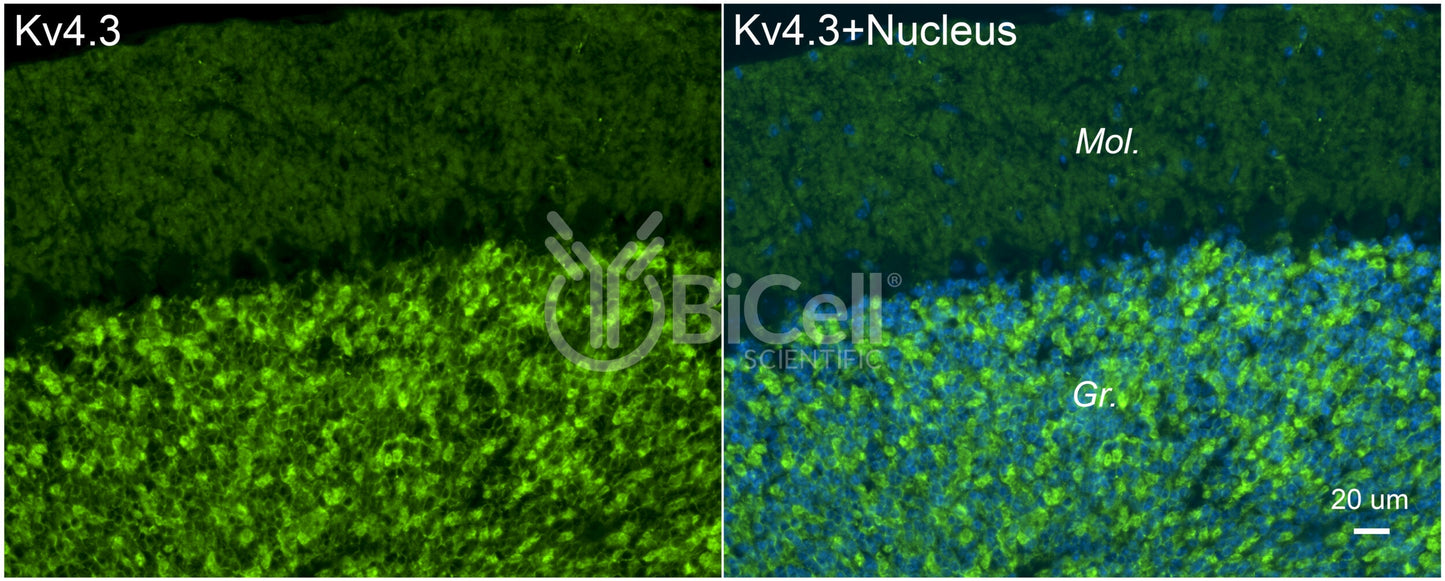
In sectioned tissue workflows, interpretation often depends on morphology; this format supports that style of readout. This matters because epitope exposure and background can vary with preparation and extraction steps. If you compare conditions, keep processing steps uniform to support clean interpretation.
If your study spans multiple model systems, it can help to define a shared reference condition for KCND3 so cross-sample contrasts stay meaningful.
If your study spans multiple model systems, it can help to define a shared reference condition for KCND3 so cross-sample contrasts stay meaningful.
If your study spans multiple model systems, it can help to define a shared reference condition for KCND3 so cross-sample contrasts stay meaningful.
As you refine hypotheses around KCND3, the fixed-section format helps keep conclusions tied to preparation context.
- Targets:
- KCND3
- Research Area:
- Neuroscience
- Application:
- IHC-P
- Reactivity:
- Human • Mouse • Rat
- Host:
- Rabbit
- Clonality:
- Polyclonal
- Isotype:
- IgG
- Immunogen:
- Synthetic peptide (13-aa) derived from the C-terminal region of mouse Kv4.3 protein
- Conjugation:
- Unconjugated
- Purification:
- Affinity Chromatography
- Concentration:
- 0.25 mg/ml
- UniProt:
- Q9UK17
- Homology:
- Synthetic peptide sequence is identical to rat sequence (showing 92.3% homology to human sequence)
- Storage Buffer:
- PBS, pH 7.2, 0.1% Sodium Azide
- Storage Temperature:
- -20°C
For Research Use Only. Not intended for diagnostic or therapeutic use.
Products may be subject to intellectual property rights.
The purchase of this product does not grant any license for commercial use, manufacturing, or clinical applications. The user is responsible for ensuring compliance with applicable laws and third-party rights.