
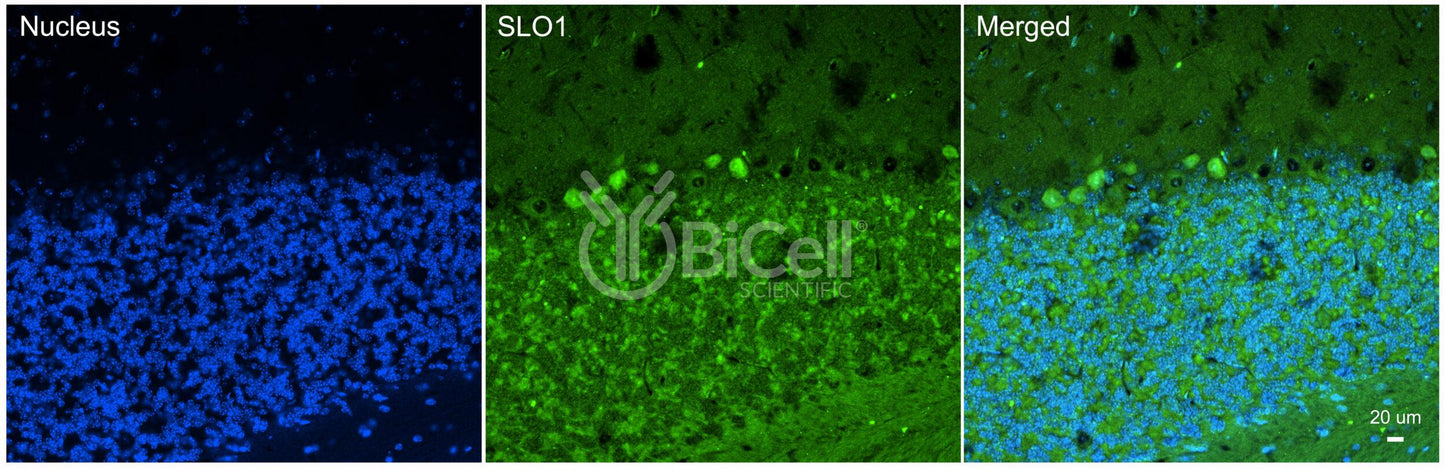
KCNMA1 (SLO1 or MaxiK or KCa1.1) Antibody - FFPE Validated

BiCell Scientific
SKU:20251-FFPE-50UL
Couldn't load pickup availability
Protein Function
This antibody helps you examine KCNMA1 while keeping condition-to-condition contrasts straightforward. KCNMA1 is a membrane protein linked to solute movement and gradient maintenance. Use matched handling so differences reflect biology rather than processing.
Tracking KCNMA1 can clarify whether changes reflect regulation, redistribution, or altered complex assembly.
Experimental Applications
Transport targets are commonly studied under stimulation conditions that alter membrane potential, osmolarity, or nutrient availability. Define inclusion criteria and controls early so replicate sets remain interpretable as the dataset grows.
In practice, target tracking can support localization mapping, relative quantification, and interaction-focused experiments without locking you into a single readout strategy.
Common experimental questions that benefit from target tracking include:
- surface versus intracellular pool distribution
- stimulus-dependent trafficking and turnover
- patterns consistent with apical or basolateral sorting
- relative abundance across engineered constructs
Workflow Perspective
Because fixation can mask epitopes, fixed-section oriented formats aim to maintain recognition after standard deparaffinization and retrieval steps. To keep comparisons consistent, align sample preparation steps and define a clear baseline for each series. Document normalization choices so collaborators can reproduce the same interpretation.
For challenging targets, pairing KCNMA1 measurements with a second marker can clarify whether differences arise from regulation, redistribution, or shifts in cell composition within the sample.
When interpreting KCNMA1, consider whether changes track with compartment identity, cell density, or perturbation timing; these factors can influence apparent signal without implying a direct causal link.
With consistent handling, the fixed-section format can make KCNMA1 comparisons easier to reproduce across runs.
- Targets:
- KCNMA1
- Research Area:
- Neuroscience
- Application:
- IHC-P
- Reactivity:
- Human • Mouse • Rat
- Host:
- Rat
- Clonality:
- Polyclonal
- Isotype:
- IgG
- Immunogen:
- Synthetic peptide (16-aa) derived from the C-terminal cytoplasmic region of human KCNMA1 protein
- Conjugation:
- Unconjugated
- Purification:
- Affinity Chromatography
- Concentration:
- 0.25 mg/ml
- UniProt:
- Q12791
- Homology:
- Synthetic peptide sequence is identical to mouse or rat sequence
- Storage Buffer:
- PBS, pH 7.2, 0.1% Sodium Azide
- Storage Temperature:
- -20°C
For Research Use Only. Not intended for diagnostic or therapeutic use.
Products may be subject to intellectual property rights.
The purchase of this product does not grant any license for commercial use, manufacturing, or clinical applications. The user is responsible for ensuring compliance with applicable laws and third-party rights.