
MKS1 (BBS13) Antibody


BiCell Scientific
SKU:90101-50UL
Couldn't load pickup availability


About the Target
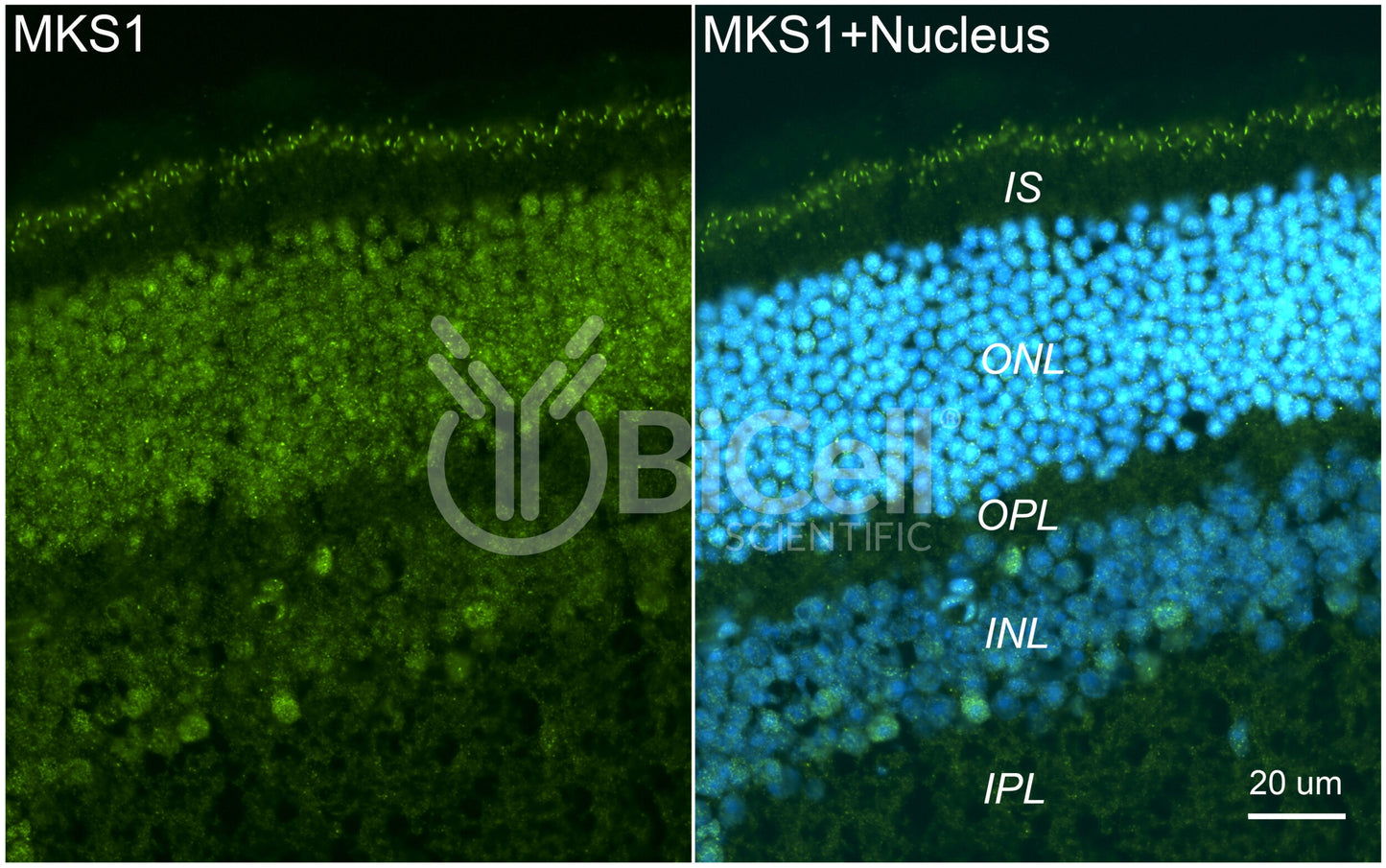
When you need to analyze MKS1 with attention to cellular organization, this antibody provides a focused option. MKS1 is a ciliary or centrosomal protein connected to microtubule-based organization. Its behavior can reflect changes in differentiation state, stress, or remodeling of cellular architecture.
In some datasets and protocols, it is referenced by the gene symbol BBS13.
Research Context
Quantitative comparisons often rely on consistent imaging parameters and clear inclusion criteria for ciliated cells. Because regulation can be multi-layered, combining abundance and localization information can sharpen conclusions.
Consider these angles when interpreting target-level changes:
- cell-cycle linked differences in localization
- changes in cilia incidence or apparent length in perturbation studies
- signal enrichment at basal bodies versus cytoplasm
Variant Considerations
For broad method development, the regular format can help you benchmark target behavior before narrowing to a specific readout style. This matters because epitope exposure and background can vary with preparation and extraction steps. If you compare conditions, keep processing steps uniform to support clean interpretation.
If your study spans multiple model systems, it can help to define a shared reference condition for MKS1 so cross-sample contrasts stay meaningful.
If your study spans multiple model systems, it can help to define a shared reference condition for MKS1 so cross-sample contrasts stay meaningful.
The regular format version supports deeper biological narratives around MKS1 without overcomplicating setup.
- Targets:
- MKS1
- Research Area:
- Cell Cycle • Developmental Biology
- Application:
- IF • IHC • WB
- Reactivity:
- Human • Mouse • Rat
- Host:
- Rabbit
- Clonality:
- Polyclonal
- Isotype:
- IgG
- Immunogen:
- Synthetic peptide (17-aa) derived from the C-terminal region of mouse MKS1 protein
- Conjugation:
- Unconjugated
- Purification:
- Affinity Chromatography
- Concentration:
- 0.25 mg/ml
- UniProt:
- Q9NXB0
- Homology:
- Synthetic peptide sequence is identical to rat sequence (showing 88.2% homology to human sequence)
- Storage Buffer:
- PBS, pH 7.2, 0.1% Sodium Azide
- Storage Temperature:
- -20°C
For Research Use Only. Not intended for diagnostic or therapeutic use.
Products may be subject to intellectual property rights.
The purchase of this product does not grant any license for commercial use, manufacturing, or clinical applications. The user is responsible for ensuring compliance with applicable laws and third-party rights.