
MKS3 (NPHP11 or Meckelin or TMEM67) (Xenopus) Antibody - FFPE Validated

BiCell Scientific
SKU:90103X-FFPE-50UL
Couldn't load pickup availability
About the Target
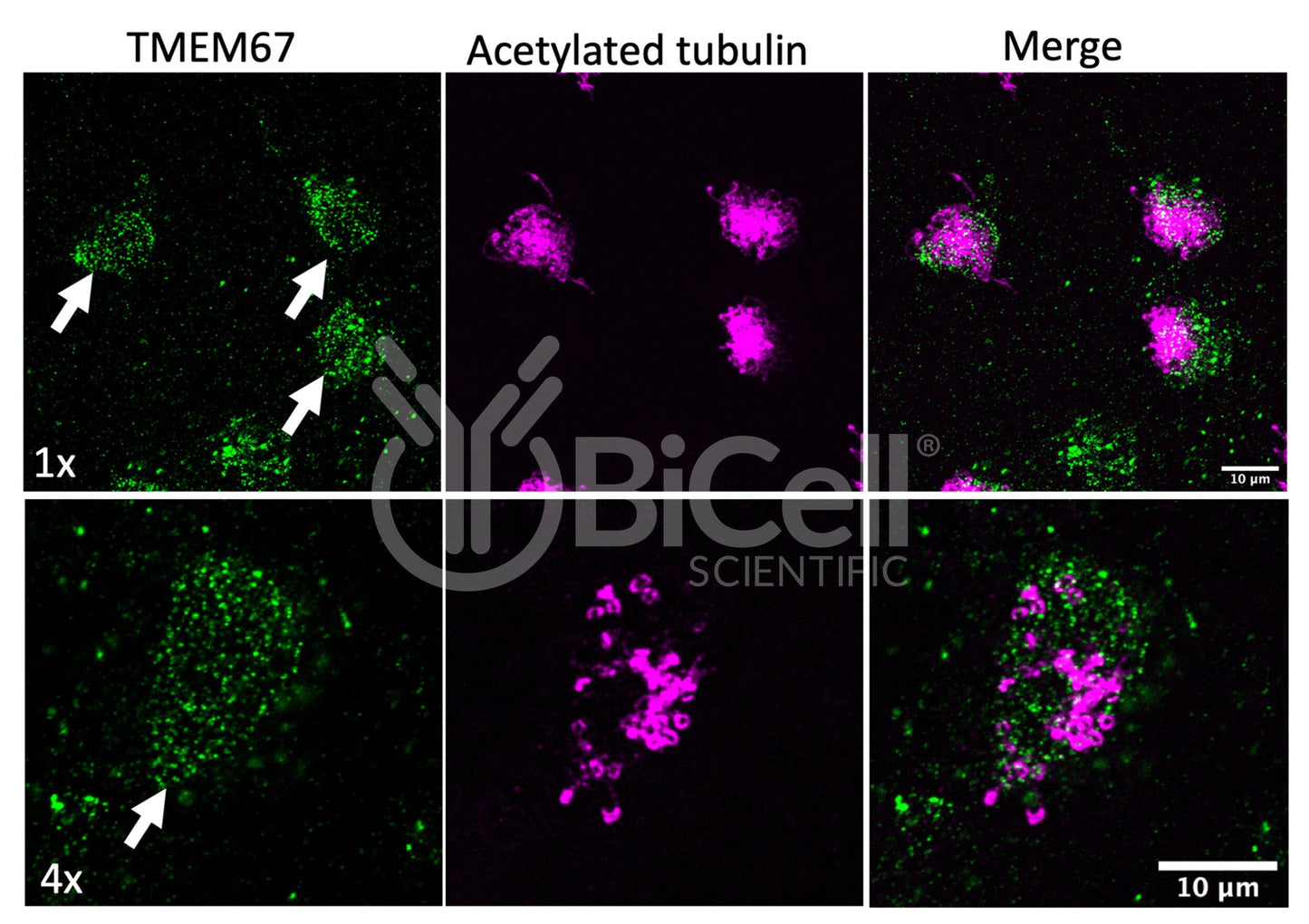
Use this antibody to examine MKS3 (NPHP11) in your model system. MKS3 is a trafficking-related component that can localize to basal bodies and ciliary axonemes. Look for shifts in distribution that track with phenotype changes.
Tracking MKS3 can clarify whether changes reflect regulation, redistribution, or altered complex assembly.
Research Context
Disruption of intraflagellar transport or basal body function can produce distinct localization signatures. Pair measurements with orthogonal readouts when interpretation is sensitive to context.
Consider these angles when interpreting target-level changes:
- signal enrichment at basal bodies versus cytoplasm
- changes in cilia incidence or apparent length in perturbation studies
- cell-cycle linked differences in localization
- co-occurrence with intraflagellar transport markers
Variant Considerations
This fixed-section oriented version is intended for paraffin-embedded tissue, where crosslinking and retrieval steps can shape epitope accessibility. This matters because epitope exposure and background can vary with preparation and extraction steps. If you compare conditions, keep processing steps uniform to support clean interpretation.
To support downstream analysis, record key context variables (culture timing, stimulation window, and extraction approach) so MKS3 patterns can be compared across experiments without guesswork.
To support downstream analysis, record key context variables (culture timing, stimulation window, and extraction approach) so MKS3 patterns can be compared across experiments without guesswork.
With a clear focus on MKS3 (NPHP11), this fixed-section option fits streamlined studies and fast iteration.
- Targets:
- TMEM67
- Research Area:
- Cell Cycle • Developmental Biology
- Application:
- IHC-P
- Reactivity:
- Human • Mouse • Rat
- Host:
- Rat
- Clonality:
- Polyclonal
- Isotype:
- IgG
- Immunogen:
- Synthetic peptide (16-aa) derived from the C-terminal region of Xenopus TMEM67 protein
- Conjugation:
- Unconjugated
- Purification:
- Affinity Chromatography
- Concentration:
- 0.25 mg/ml
- UniProt:
- Q5HYA8
- Homology:
- Synthetic peptide sequence showing 75% homology to mouse sequence
- Storage Buffer:
- PBS, pH 7.2, 0.1% Sodium Azide
- Storage Temperature:
- -20°C
For Research Use Only. Not intended for diagnostic or therapeutic use.
Products may be subject to intellectual property rights.
The purchase of this product does not grant any license for commercial use, manufacturing, or clinical applications. The user is responsible for ensuring compliance with applicable laws and third-party rights.