
TNFRSF11A (RANK or CD265) Antibody - FFPE Validated

BiCell Scientific
SKU:52611-FFPE-50UL
Couldn't load pickup availability
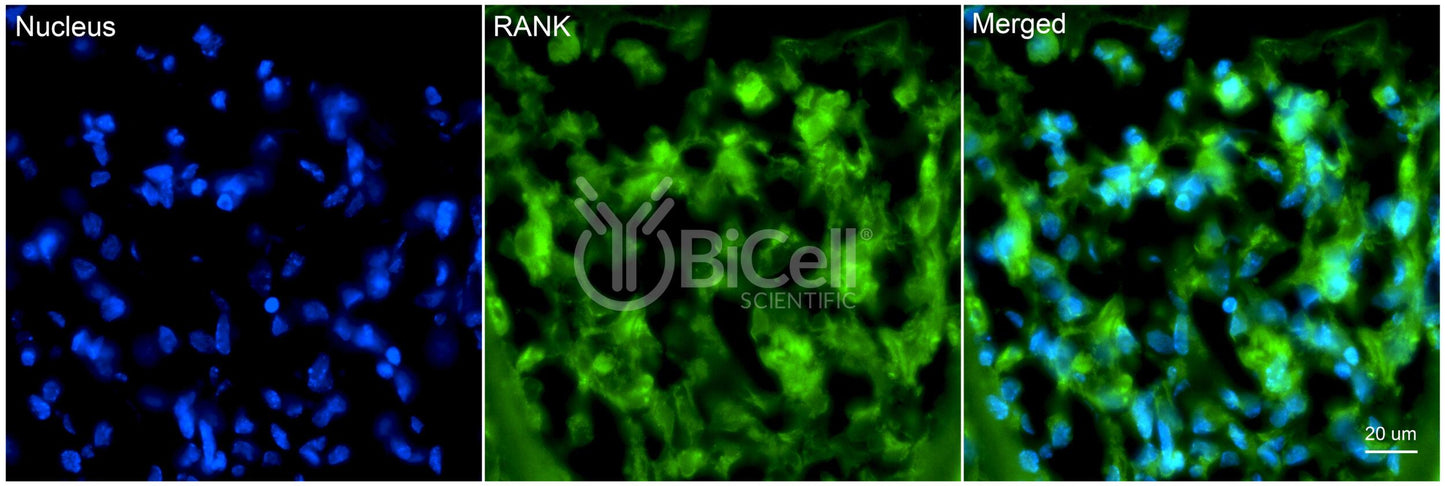
Biological Background
This antibody supports efforts to assess TNFRSF11A and interpret it within interaction networks. TNFRSF11A is a signaling protein that can relay information through phosphorylation and complex assembly. Many projects interpret this target alongside interacting partners, upstream cues, and downstream readouts.
In some datasets and protocols, it is referenced by the gene symbol RANK.
Use in the Laboratory
Perturbations such as inhibitors or ligand stimulation can drive rapid shifts in localization or complex formation. Considering complex membership and compartment shifts can clarify whether changes reflect signaling or redistribution.
Many targets show context-dependent localization, so comparisons across matched conditions can reveal meaningful patterns.
To keep datasets interpretable, labs often document:
- interaction patterns within multi-protein complexes
- condition-to-condition comparisons with matched controls
- localization shifts between cytoplasm, membrane, and nucleus
Version Notes
For paraffin-embedded samples, fixation history and retrieval strategy matter; this option is aligned to those constraints. If your study compares multiple conditions, keep acquisition and processing settings stable to avoid confounding.
To support downstream analysis, record key context variables (culture timing, stimulation window, and extraction approach) so TNFRSF11A patterns can be compared across experiments without guesswork.
For challenging targets, pairing TNFRSF11A measurements with a second marker can clarify whether differences arise from regulation, redistribution, or shifts in cell composition within the sample.
Use the fixed-section version to relate TNFRSF11A behavior to upstream cues and downstream consequences.
- Targets:
- TNFRSF11A
- Research Area:
- Cell Signaling • Developmental Biology • Immunology • Inflammation
- Application:
- IHC-P
- Reactivity:
- Human • Mouse • Rat
- Host:
- Rat
- Clonality:
- Polyclonal
- Isotype:
- IgG
- Immunogen:
- Synthetic peptide (16-aa) derived from the C-terminal cytoplasmic region of mouse TNFRSF11A protein
- Conjugation:
- Unconjugated
- Purification:
- Affinity Chromatography
- Concentration:
- 0.25 mg/ml
- UniProt:
- Q9Y6Q6
- Homology:
- Synthetic peptide sequence is identical to rat sequence (showing 68.8% homology to human sequence)
- Storage Buffer:
- PBS, pH 7.2, 0.1% Sodium Azide
- Storage Temperature:
- -20°C
For Research Use Only. Not intended for diagnostic or therapeutic use.
Products may be subject to intellectual property rights.
The purchase of this product does not grant any license for commercial use, manufacturing, or clinical applications. The user is responsible for ensuring compliance with applicable laws and third-party rights.